Tanzania Vanilla: Market, Origins & Sourcing Guide
Overview
Vanilla is a real, if minor, part of Tanzania’s spice economy. Madagascar alone shipped roughly 4,442 tonnes of vanilla worth about $225.9 million in 2024 — an estimated 61.5% of global export value. Tanzania’s comparable figure, per UN Comtrade/World Bank data, was about 15,878 kg (under 16 tonnes) of vanilla exports in 2023, worth roughly $594,100. Those are different years and not a like-for-like comparison, but the order of magnitude is unmistakable: Tanzania is a marginal player, not a competitor to Madagascar in volume terms. What Tanzania has is a growing base of smallholder farmers for whom vanilla has become a meaningful alternative cash crop to coffee and bananas.
Production & Growing Regions
Multiple sources consistently identify Kagera (northwest, around Bukoba), Kilimanjaro (particularly Moshi, including Uswaa and Mamba villages) and Morogoro as the established production zones. Other reporting additionally lists Njombe, parts of Mbeya/Songwe, Tanga (Muheza), and Zanzibar/Pemba as emerging areas, though less consistently corroborated. In Kagera, one 2020 account put active vanilla farmers at roughly 5,332. On the Kilimanjaro side, Natural Extracts Industries (NEI), headquartered in Arusha, has built a direct-sourcing model reported at around 1,200 farmers in Moshi in 2021, growing to roughly 6,000 farmers tending over 500,000 vines per a later partnership page. Vanilla is a slow crop: vines typically need two to three years before first flowering, and roughly nine months from flower to harvest-ready pod.
Curing Process
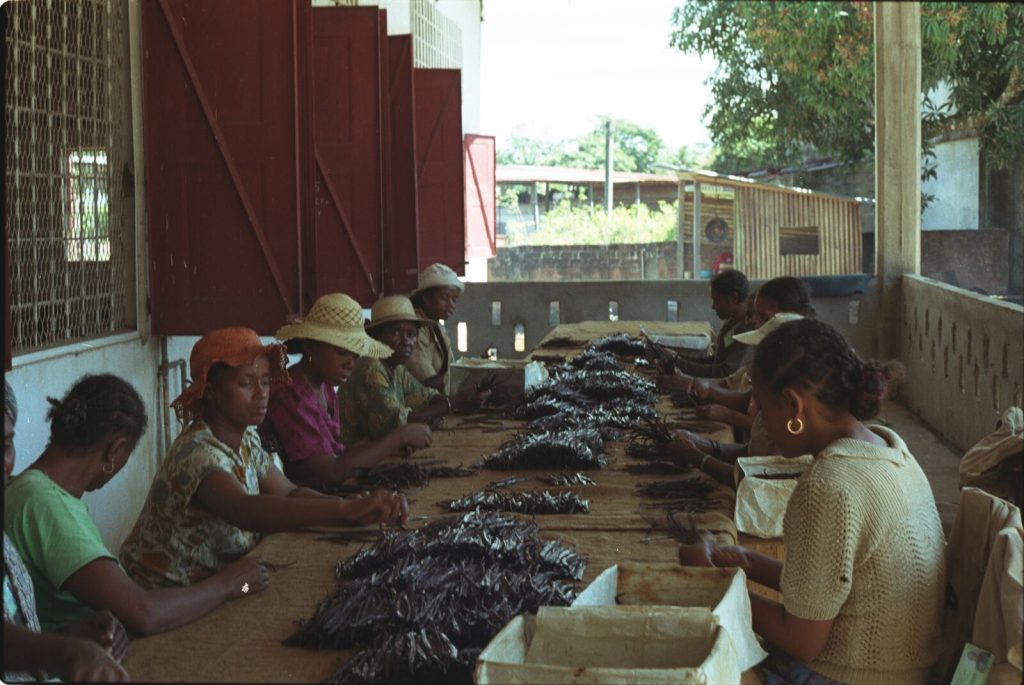
Vanilla is essentially flavorless straight off the vine — the characteristic aroma develops only through curing: (1) killing/wilting — pods scalded around 63–65°C to stop vegetative growth; (2) sweating — beans stacked and insulated at 45–65°C for roughly 7–10 days; (3) drying — slow drying, alternating sun and shade over three to four weeks, down to roughly 25–35% moisture; (4) conditioning — cured beans rest in closed boxes for one to six months so aroma compounds equalize. Tanzanian industry commentary specifically flags poor curing, drying and storage practice as a live quality-control problem for the sector.
Quality & Grading
Grade A (“gourmet”) beans are whole, long (commonly around 15cm+), dark, plump and oily-looking with no blemishes, at roughly 30–35% moisture. Grade B (“extract grade”) beans are shorter, drier (roughly 15–25% moisture) or show minor defects. Damaged or short pods are sold as “cuts” at a further discount. Kagera vanilla has historically carried a strong quality reputation tied to high vanillin content, though one account reports vanillin content falling from about 3.3% in 2010 to 2.5% in 2015, linked to smuggling and weaker quality control — a signal that Tanzania’s quality edge depends on continued investment in proper curing.
Market Volatility Context
Global vanilla prices are exceptionally volatile. Madagascar vanilla was reported around $50.86/kg as of January 2024 export unit-value data (itself down about 74% year-on-year from an earlier spike), while European gourmet Bourbon vanilla has traded in the €180–250+/kg range through 2024–2026, with historic prices exceeding €500/kg during 2018–2021 — these measure different things (blended export unit value vs. specific gourmet-grade pricing) and should never be treated as directly comparable. On the Tanzanian farmgate side, dried vanilla was reported around TZS 10,000–15,000/kg in 2021, versus a much wider TZS 35,000–800,000/kg range reported more recently across raw, wholesale and premium categories.
Trade & Export Context
2023 exports (HS 090500) totaled about 15,878 kg worth roughly $594,100, with the United States the largest destination by value (about $422,560, 3,404 kg) and France the largest by volume (about 10,700 kg, $114,720); smaller volumes went to the UK, Denmark, Switzerland, Israel, Germany, Cuba, India and Austria. Government spice-sector strategy currently prioritizes clove, pepper, ginger, cinnamon and cardamom for near-term export development, with vanilla positioned as a longer-term opportunity contingent on value-addition, certification and branding rather than raw-bean volume growth.
Current Market
| Market | Type | Grade | Price | Observed | Source |
|---|---|---|---|---|---|
| Tanzania | Export | — | USD 32.48/kg | 1 Jan 2024 | UN Comtrade unit value (via Selina Wamucii) |
- The Citizen — Farmers strike gold with vanilla — https://www.thecitizen.co.tz/tanzania/magazines/farmers-strike-gold-with-vanilla--2566906 — 2026-09-24
- World Bank WITS (UN Comtrade) — Tanzania Vanilla exports by country, 2023 — https://wits.worldbank.org/trade/comtrade/en/country/TZA/year/2023/tradeflow/Exports/partner/ALL/product/090500 — 2026-09-24
- Common Fund for Commodities — NEI – Fostering livelihoods of vanilla farmers in Tanzania — https://www.common-fund.org/nei-fostering-livelihoods-vanilla-farmers-tanzania — 2026-09-24
- allAfrica.com — Tanzania: Vanilla Lifts Kagera Farmers From Poverty — https://allafrica.com/stories/202011040736.html — 2026-09-24
- Selina Wamucii — Vanilla Price in Madagascar — https://www.selinawamucii.com/insights/prices/madagascar/vanilla/ — 2026-09-24
- Terravanilla — Madagascar Bourbon Vanilla Prices 2024-2026 — https://terravanilla.fr/en/madagascar-vanilla-prices-2024-2026-trends-analysis-and-outlook/ — 2026-09-24