The Same Harvest, Two Prices: What Trade Data Reveals About Tanzania’s Vanilla Market
Published 25 September 2026 · Commodities.tz Editorial
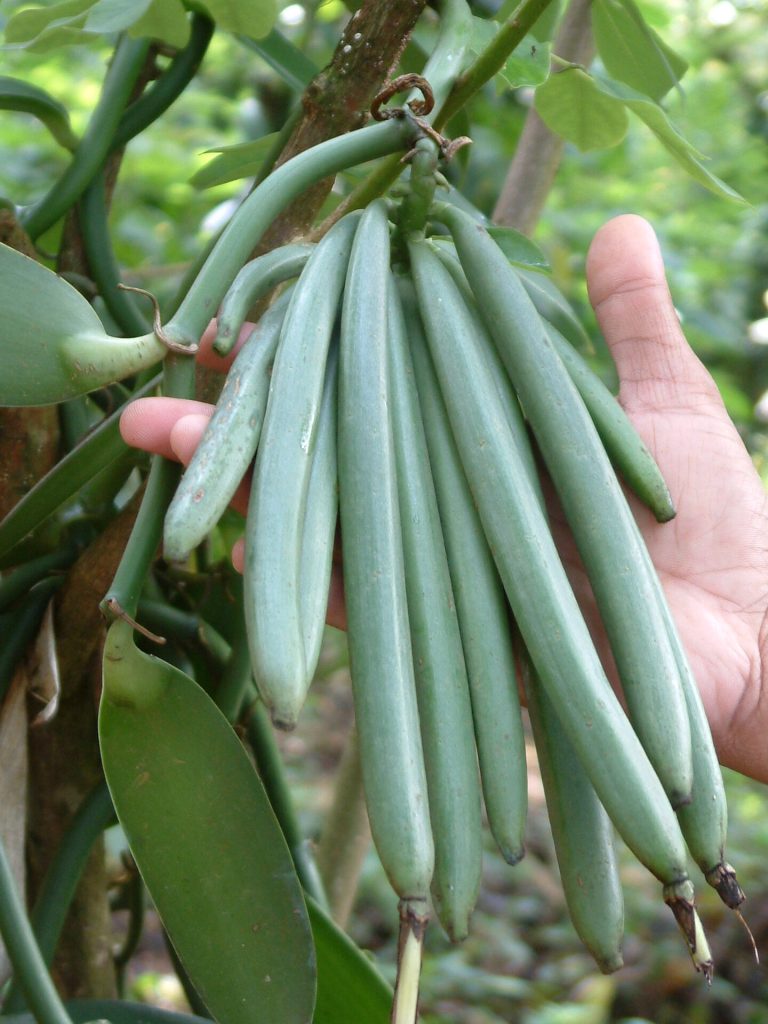
In 2023, Tanzania exported 15,878 kilograms of vanilla to eleven countries, earning a combined $594,100. Madagascar, in the same year, exported 1.4 million kilograms worth $271.7 million. Tanzania's entire annual harvest for export is smaller than what Madagascar ships out most weeks. By value, Tanzania ranks around 32nd among the world's vanilla exporters, according to UN Comtrade data compiled by the World Bank's World Integrated Trade Solution (WITS) — a rounding error against an industry Madagascar has defined for a century.
That smallness is the point. Tanzania has no ability to move the global vanilla price. It can only receive it. And the 2023 export data, read closely, shows exactly how unevenly that price lands depending on which buyer is doing the receiving.
Look at Tanzania's two largest customers that year. The United States bought 3,404 kilograms of Tanzanian vanilla for $422,560 — a unit price of $124.16 per kilogram. France bought more than three times the volume, 10,700 kilograms, for just $114,720 — a unit price of $10.72 per kilogram. Same country of origin, same calendar year, an almost twelvefold gap in what buyers paid per kilogram.
This is not a rounding artifact. It reflects two different markets buying two different things.
How Madagascar's floor became everyone's ceiling
The gap is new. In 2021, Tanzania's exports to the United States and France were priced almost identically — $114.64 per kilogram for the US-bound lots, $118.62 for the French ones, according to the same WITS trade data. Whatever separates the two channels today, it did not separate them two years earlier.
What changed in between was a policy collapse eight time zones away. In February 2023, Madagascar's government imposed a minimum export price of $250 per kilogram for that season's vanilla, an attempt to defend farmer incomes after years of price erosion. The floor lasted about two months. Under pressure from major international buyers, Madagascar cancelled it in April 2023, and the market did what floors are meant to prevent: it fell through. Prices for lower grades dropped below $20 per kilogram within the year, according to trade-policy tracker Global Trade Alert and commodity intelligence firm Mintec. Madagascar's own replacement rule — a vaguely enforced "cost price" of roughly $140-150 per kilogram for cured beans — did little to stop bulk and cut-grade material from trading well under that line.
Because Madagascar supplies the large majority of the world's vanilla, its benchmark effectively prices everyone else's crop too. Tanzania's French-bound exports, priced at commodity/extraction-grade levels, cratered almost exactly in line with that global low-grade collapse: down 91 percent per kilogram between 2021 and 2023. The US-bound exports, by contrast, held their value and even edged up slightly.
What the divergence is probably telling buyers
Trade statistics don't record bean grade, so the exact explanation can't be read off the customs data alone. But the pattern lines up with a well-documented structural fact about where French and American vanilla imports typically go. France, according to a market analysis by CBI (the Centre for the Promotion of Imports from developing countries, part of the Dutch government), functions less as a consumer market for whole beans and more as Europe's vanilla processing and re-export hub — a role built around the fragrance and flavour industry centred on the town of Grasse and the trading infrastructure of the port of Marseille. CBI's own trade figures show France's ground-vanilla imports falling 58 percent between 2020 and 2024 even as its imports of vanilla oleoresin — the concentrated extract used in industrial flavouring — rose from 28 to 504 tonnes over the same period. France, in other words, is buying more raw material for extraction and less finished whole bean.
If Tanzania's France-bound shipments are weighted toward that extraction-grade, bulk end of the market, they would be priced directly off Madagascar's crashed commodity benchmark — which is what the 2023 numbers show. Shipments bound for higher-value, more discriminating gourmet buyers, plausibly concentrated in the smaller US-bound lots, would be comparatively insulated, since that segment prices on flavour and traceability rather than bulk extract economics. The lesson for a buyer evaluating Tanzania-origin vanilla is not that Tanzania's crop is intrinsically cheap or expensive — it's that the FOB number alone tells you almost nothing until you know which of these two markets a given lot is priced into.
The net effect at the country level was a shrinking pie shared out less favourably. Total Tanzanian vanilla export earnings fell 53 percent between 2021 and 2023 — from $1.27 million to $594,100 — even though the physical volume shipped actually rose 29 percent. Exporters and, ultimately, farmers moved more beans for roughly half the money. And the most recent single data point available, Tanzania's 2024 vanilla exports to the United States, is starker still: just $13,350, down from $422,560 the year before — a collapse of nearly 97 percent in what had been Tanzania's highest-value channel, per UN Comtrade figures compiled by Trading Economics.
The view from Kagera
That number shows up on the ground as a wage problem, not an abstraction. In Kagera — historically Tanzania's vanilla heartland, alongside Kilimanjaro and Morogoro — farmers interviewed by Pan African Visions in March 2025 described farm-gate prices that had fallen from around 50,000 Tanzanian shillings per kilogram during the boom years of the early 2000s to roughly 1,500 shillings per kilogram now, a collapse of roughly 97 percent in local-currency terms. Hand-pollination and curing labour, paid at a flat monthly rate regardless of the price vanilla later fetches, has become hard to justify against the crop's return. Some Kagera farmers described replanting land back into coffee. Tanzania's Deputy Minister for Agriculture, David Silinde, has acknowledged the problem publicly and floated an auction-based sales system as a partial fix, though no such mechanism was operating as of the reporting.
Against that backdrop, the structural differences between Tanzania's own exporters look less like branding choices and more like different bets on how to escape price-taker status. Natural Extracts Industries, trading as Viva Vanilla out of Moshi in the Kilimanjaro region, has built an integrated grower-to-export model — curing in-house using the traditional Bourbon method across processing centres it operates in Tanzania and Uganda, working with a combined smallholder network the company puts at more than 13,000 farmers across both countries. Viridium Tanzania, based in Morogoro and founded in 2021, takes a different route: a centralised processing facility buying fresh-harvested vanilla, clove and cardamom from smallholders it does not itself employ, aimed at Gulf and European buyers. Farmer associations like Muleba Vanilla Development Association in Kagera represent a third model again — aggregation without the same degree of downstream processing control.
None of these structures can insulate Tanzania from a floor collapsing in Antananarivo. But they do determine how much of whatever price does land actually reaches a farmer, rather than dissipating in a bulk-grade shipment priced off someone else's crash.
- Tanzania Vanilla exports by country, 2023 (WITS/World Bank) — https://wits.worldbank.org/trade/comtrade/en/country/TZA/year/2023/tradeflow/Exports/partner/ALL/product/090500
- Tanzania Vanilla exports by country, 2021 (WITS/World Bank) — https://wits.worldbank.org/trade/comtrade/en/country/TZA/year/2021/tradeflow/Exports/partner/ALL/product/090500
- Vanilla exports by country, 2023 world total (WITS/World Bank) — https://wits.worldbank.org/trade/comtrade/en/country/ALL/year/2023/tradeflow/Exports/partner/WLD/product/090500
- Madagascar: USD 250 export tax on vanilla — Global Trade Alert — https://globaltradealert.org/intervention/117730-madagascar-usd-250-export-tax-on-vanilla
- Madagascar lifts minimum export price on vanilla — Mintec Global — https://www.mintecglobal.com/top-stories/madagascar-lifts-minimum-export-price-on-vanilla
- The European market potential for vanilla extract — CBI — https://www.cbi.eu/market-information/natural-food-additives/vanilla-extract/market-potential
- Vanilla's Broken Promise: How a Once-Golden Crop Became a Struggle for Survival in Tanzania — Pan African Visions — https://panafricanvisions.com/2025/03/vanillas-broken-promise-how-a-once-golden-crop-became-a-struggle-for-survival-in-tanzania/
- Tanzania Exports of vanilla beans to United States — Trading Economics/UN Comtrade — https://tradingeconomics.com/tanzania/exports/united-states/vanilla-beans
- Heart of East Africa – Viva Vanilla — Natural Extracts Industries Ltd — https://nei-ltd.com/viva-vanilla/
- Viridium Tanzania Ltd — Tanzania Spices — https://www.tanzaniaspices.org/viridium-tanzania-ltd