The Missing Tonnes: What Tanzania’s Vanilla Export Data Doesn’t Show
Published 26 September 2026 · Commodities.tz Editorial
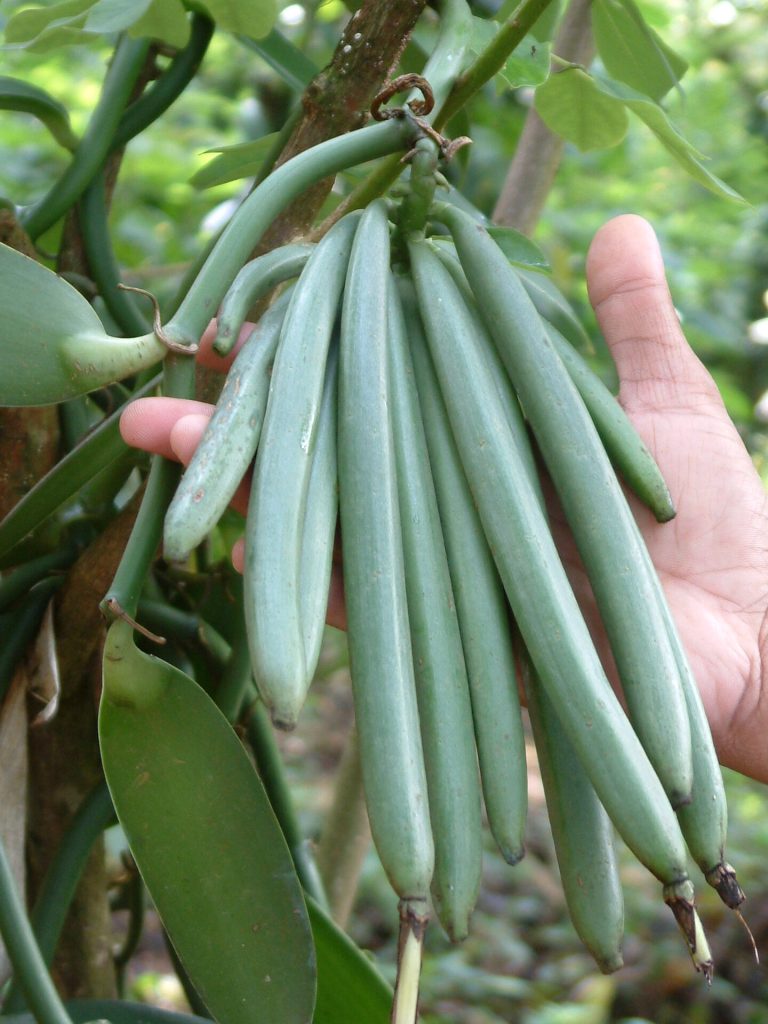
Two official-ish numbers about Tanzanian vanilla do not fit together, and the gap between them is more useful to a buyer than either number on its own. Tanzania’s Ministry of Agriculture, as reported by Anadolu Agency in 2021, put national vanilla production at 1,949 tonnes in 2020, up from 229.8 tonnes in 2015. Formal customs data tells a very different story about how much of that crop leaves the country as vanilla.
What the customs data actually shows
According to UN Comtrade figures accessed via the World Bank’s World Integrated Trade Solution (WITS) platform, Tanzania’s total recorded exports of vanilla (HS code 090500) in 2023 were just 15,878 kilograms, worth $594,100 — an average unit value of about $37.40 per kilogram. The destinations were the United States ($422,560 across 3,404 kg, roughly 71% of total export value), France ($114,720 across 10,700 kg), the United Kingdom, Denmark, Switzerland, Israel, Germany, Cuba, India, and Austria, in descending order of value. Fifteen point nine tonnes of recorded exports against nearly 2,000 tonnes of reported production is not a rounding error; it’s two orders of magnitude apart.
Put in regional context, the mismatch looks even stranger. Uganda — a much newer entrant to commercial vanilla than Tanzania — recorded formal exports of 138,836 kilograms worth $6.3 million through July 2024 alone, at an average price of $45.34 per kilogram, according to trade data compiled by IndexBox. That’s roughly nine times Tanzania’s entire 2023 export volume, from a country with a shorter vanilla-growing history and, by most production estimates, a smaller crop.
Where does the rest of it go?
There is no single confirmed explanation, and any buyer relying on this should treat it as an open question rather than a settled fact — but several plausible, non-exclusive answers follow from what’s publicly known about how Tanzania’s vanilla actually moves. First, a meaningful share of Tanzania’s production doesn’t leave the country as raw or cured beans classified under HS 090500 at all. Natural Extracts Industries (NEI), the Moshi-based processor that now sources from more than 6,000 smallholders across Kilimanjaro, Morogoro, and Kagera, is vertically integrated from farm to “beans, powder, liquid and dry extracts,” per its own description reported by the Common Fund for Commodities — meaning a substantial portion of Tanzanian vanilla likely leaves the country already processed into extract or flavoring product, which is tracked under entirely different customs codes than whole vanilla beans.
Second, informal and cross-border trade is a known feature of East African spice markets generally, and vanilla specifically has a documented history of being moved through neighboring countries before final export — a pattern that would shift Tanzanian-grown volume onto another country’s export ledger rather than Tanzania’s own. Third, the production figure itself may be measuring something different from what the export figure measures: ministry crop estimates in many countries capture green-bean-equivalent output at the farm level, before the roughly 4.5-to-1 to 6-to-1 weight loss that vanilla undergoes during curing, while export statistics necessarily measure the finished, cured product. That alone would shrink a 1,949-tonne green-bean estimate to somewhere in the 300–400-tonne range of cured-bean-equivalent — still well above 15.9 tonnes, but a smaller gap.
The practical takeaway
For a buyer trying to source Tanzanian vanilla at any real volume, the country-level trade data is not a reliable signal of what’s available, because so little of the crop appears to travel as raw beans through channels that get captured in customs statistics. The more traceable route into this market is direct relationships with vertically integrated processors like NEI, whose farmer networks, agronomist coverage, and household-level income data are independently documented — rather than expecting bulk shipments of Tanzanian green or cured beans to show up in bilateral trade figures the way Madagascar’s or Uganda’s do.
- World Bank WITS / UN Comtrade, "Tanzania Vanilla exports by country, 2023" — https://wits.worldbank.org/trade/comtrade/en/country/TZA/year/2023/tradeflow/Exports/partner/ALL/product/090500 — 2026-09-26
- IndexBox, "Uganda's Vanilla Market Report 2026" (data as of July 2024) — https://www.indexbox.io/store/uganda-vanilla-market-analysis-forecast-size-trends-and-insights/ — 2026-09-26
- Anadolu Agency, "Tanzanian farmers choose vanilla over coffee for profits" (27 October 2021) — https://www.aa.com.tr/en/africa/tanzanian-farmers-choose-vanilla-over-coffee-for-profits/2404459 — 2026-09-26
- Common Fund for Commodities, "NEI – Fostering livelihoods of vanilla farmers in Tanzania" — https://www.common-fund.org/nei-fostering-livelihoods-vanilla-farmers-tanzania — 2026-09-26
- Tridge, "Vanilla Bean Suppliers, Export Data & Price Trends | Global Market Overview 2026" — https://www.tridge.com/market-overview/vanilla-bean — 2026-09-26