The Twelve-Hour Flower: Hand Pollination and the Labor Behind Every Tanzanian Vanilla Pod
Published 26 September 2026 · Commodities.tz Editorial
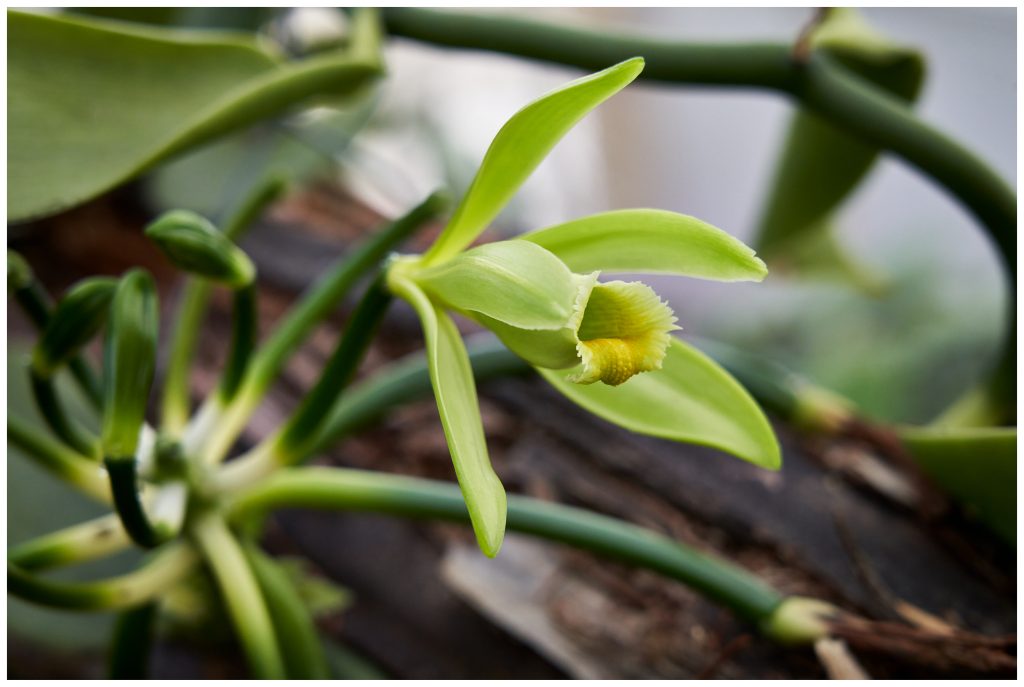
Vanilla is an orchid, and like most orchids it evolved alongside a specific pollinator. In its native Mexico that’s Melipona, a stingless bee, along with certain hummingbirds. Neither exists in Tanzania, or anywhere else vanilla is now commercially grown outside Mexico. Every pod harvested in Kagera, Kilimanjaro, or Morogoro exists because a person opened that flower by hand and pollinated it — a discipline that hasn’t fundamentally changed since a 12-year-old enslaved boy named Edmond Albius worked it out on Réunion island in 1841.
A technique invented on the fly, in bondage
Before Albius, plantation owners on Réunion and elsewhere had tried and failed for years to get imported vanilla vines to fruit outside Mexico. Albius, using a thin stick to lift the membrane separating the flower’s male and female parts and then pressing them together with his thumb, found a method that worked. According to accounts documented by the Linnean Society and the Smithsonian’s National Museum of African American History and Culture, his technique spread first through Réunion and then, via French colonial agriculture, into Madagascar and East Africa — and it is essentially the same technique used in Kagera today. Albius himself died in poverty, uncredited during his lifetime for an innovation that turned vanilla into one of the world’s most valuable spices by weight.
Why the twelve hours matter
The technical constraint that makes this labor-intensive rather than merely fiddly is timing. Each vanilla flower opens once, for a single morning, and closes by early afternoon — a window of roughly twelve hours. If it isn’t pollinated within that window, it wilts and drops without ever forming a pod. A vine can produce dozens of flowers across a flowering season, often opening on the same morning, which means a smallholder with even a modest planting has to be in the field, checking vines, every single day the vines are in flower — not a task that tolerates being postponed.
This is also, according to organizations tracking labor conditions in African vanilla supply chains such as Verité, disproportionately work performed by women, who typically combine it with the rest of the farm’s daily labor demands. In Kagera, farmer Clementina Buberwa, whose vines take three to four years to reach the 7–15 kilogram-per-vine yield she now gets, has described 14-hour days during the harvest and flowering period — a schedule set less by choice than by the biology of the flower.
What this means for cost and quality
Because pollination has to happen flower-by-flower, vanilla doesn’t scale the way row crops do. A larger planting doesn’t reduce the labor-per-kilogram the way mechanized harvesting reduces it for maize or rice — it just requires proportionally more skilled hands during a narrow window. This is a structural reason vanilla suits smallholder agriculture (labor-rich, land-poor) better than plantation-style consolidation, and it’s also why quality variance between farmers in the same village can be wide: a pollinator who misses the window, or damages the flower’s ovary while forcing the anther and stigma together, produces a shrivelled or malformed pod regardless of how well the eventual bean is cured.
For buyers evaluating a Tanzanian supply relationship, the practical implication is that pod quality is substantially determined before curing ever begins — in a labor step that happens on the vine, months before a bean reaches a processor. Farmer training in pollination technique, not just post-harvest handling, is where yield-per-vine and pod uniformity are actually won or lost. Organizations like NEI, which has built its sourcing model around embedded agronomists working directly with smallholder households, treat this stage — not the curing shed — as the first quality-control point in the chain.
- Smithsonian National Museum of African American History and Culture, "Edmond Albius, Horticulturist" — https://www.searchablemuseum.com/edmond-albius-horticulturist/ — 2026-09-26
- The Linnean Society, "Edmond Albius: the boy who revolutionised the vanilla industry" (16 October 2019) — https://www.linnean.org/news/2019/10/16/edmond-albius — 2026-09-26
- Verité, "Vanilla" (labor conditions in African vanilla supply chains) — https://verite.org/initiative/africa/commodities/vanilla/ — 2026-09-26
- Anadolu Agency, "Tanzanian farmers choose vanilla over coffee for profits" (27 October 2021) — https://www.aa.com.tr/en/africa/tanzanian-farmers-choose-vanilla-over-coffee-for-profits/2404459 — 2026-09-26
- Common Fund for Commodities, "NEI – Fostering livelihoods of vanilla farmers in Tanzania" — https://www.common-fund.org/nei-fostering-livelihoods-vanilla-farmers-tanzania — 2026-09-26